Summarised from Hydrogeology of the Main Karoo Basin: Current Knowledge and Future Research Needs WRC Report Project K860 (2001).
Introduction
The lithostratigraphic units of the Karoo Supergroup outcrop concentrically around the Main Karoo Basin and include the following:
1. Dywka Group: The Group consists mainly of diamictite (tillite) which is generally massive with little jointing, but it may be stratified in places. Subordinate rock types are conglomerate, sandstone, rhythmite and mudrock (both with and without dropstones). In the southern part of the basin, under the influence of the Cape Fold Belt, the diamictite display a distinctive 'tombstone' morphology as a result of selective weathering along axial-plane cleavage.
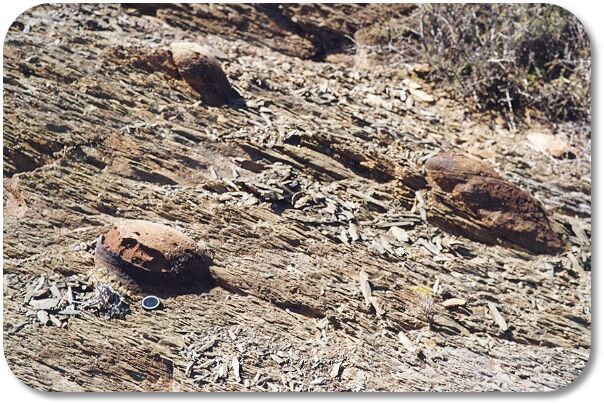
Source: http://web.uct.ac.za
2. Ecca Group: This Group consists of the following Formations:
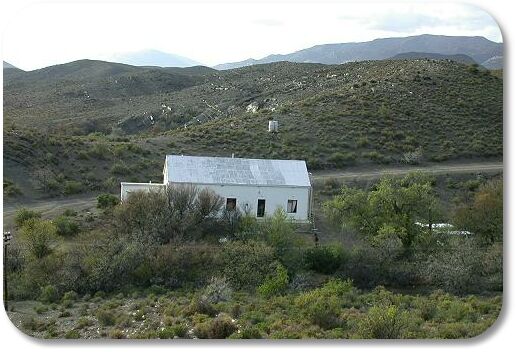
Source: http://web.uct.ac.za
3. Beaufort Group consists of the following subgroups:
b) The early Triassic Tarkastad Subgroup is characterized by a greater abundance of both sandstone and red mudstone when compared with the Adelaide Subgroup.
c) The Katberg Formation sandstones are light brownish grey to greenish grey, fine- to medium‑grained and contain scattered pebbles up to 15 cm in diameter within the coastal outcrops. Oval to spherical calcareous concretions, 3–10 cm in diameter, are also common. The Burgersdorp Formation sandstones are greenish grey to light brownish grey and are fine‑grained. The average thickness of sandstone units in the central portion of the Formation in the main outcrop area is 2m.
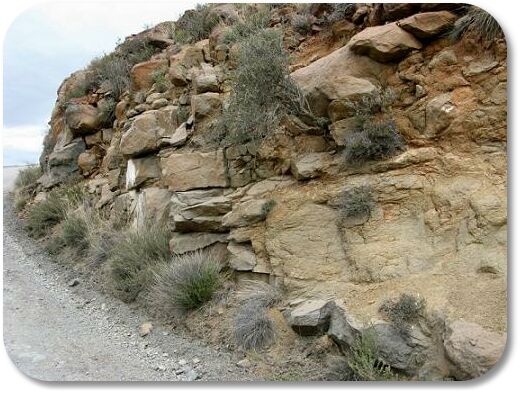
Source: http://farm3.static.flickr.com
4. Molteno, Elliot and Clarens Formations
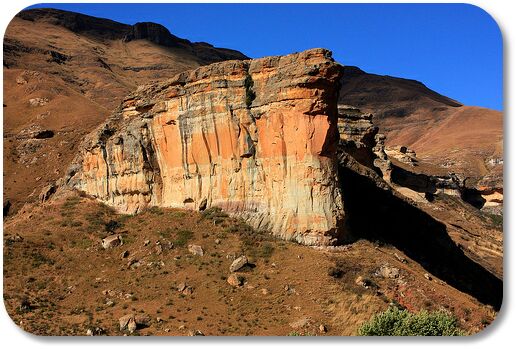
Source: http://farm4.static.flickr.com
Dwyka Group
The Dwyka diamictite and shale have very low hydraulic conductivities [~ 10 -11 to 10 -12 m.s -1 and virtually no primary voids. The Dwyka Group constitutes a very low-yielding fractured aquifer and water is confined within narrow discontinuities like jointing and fracturing. They therefore tend to form aquitards rather than aquifers. The few sandstone bodies deposited in the glacial valleys of the northern facies are very limited in extent, and sealed off by the diamictite or mudrock. Since the Dwyka sediments were deposited mainly under marine conditions, the water in these aquifers tends to be saline. Exploitable aquifers thus only exist at few localities in the Basin, where sand and gravel were deposited on beaches or where the Dwyka Group was fractured significantly. In general, the Dwyka Group is thus not an ideal unit for the large-scale development of groundwater.
Ecca Group
The Ecca Group consists mainly of shales that are very dense, they are often overlooked as significant sources of groundwater. One should thus not neglect the Ecca rocks as possible sources for groundwater, especially the deltaic sandstone facies. The permeabilities of these sandstones are usually very low. The main reason for this is that the sandstones are usually poorly sorted.
Beaufort Group
The geometry of these aquifers is complicated by the lateral migration of meandering streams over a floodplain. Aquifers in the Beaufort Group will thus not only be multi-layered, but also multi-porous with variable thicknesses. The contact plane between two different sedimentary layers will cause a discontinuity in the hydraulic properties of the composite aquifer. The life-span of a high-yielding borehole in the Beaufort Group may therefore be limited, if the aquifer is not recharged frequently.
Molteno, Elliot and Clarens Formations
The characteristics and depositional history of the Molteno Formation indicate that the Formation should form an "ideal" aquifer. This applies not only to the pebble conglomerates and coarse-grained sandstones at the base of the Formation, but also to the other sedimentary bodies.
The largest part of the Elliot Formation consists of red mudstone. The Formation thus represents more of an aquitard than an aquifer.
The Clarens Formation consists almost entirely of well-sorted, medium- to fine-grained sandstones, deposited as thick consistent layers. It is poorly fractured and has a very low permeability. The Formation may therefore be able to store large volumes of water, but is unable to release it quickly.